


Foundation-Free Vertical Greening: The Green Tower in Fulda
- MobiPanel green wall
- Location: Fulda, Germany
- Dealer: GEFÄSSERIE - Die Wandbegrüner GmbH
Project facts: Foundation-Free vertical greening
| Location | Fulda, Germany |
| Project type | Free-standing, mobile vertical greening without a foundation for public street space |
| Solution | MobiPanel: pre-grown plant wall system, integrated into the ALPAKA Green Tower |
| Project partner | GEFÄSSERIE – Die Wandbegrüner GmbH |
| Application | Urban greening in a dense city-centre area: enhancing the streetscape |
| Environmental impact |
|
 – Particulate matter
 + Amenity value
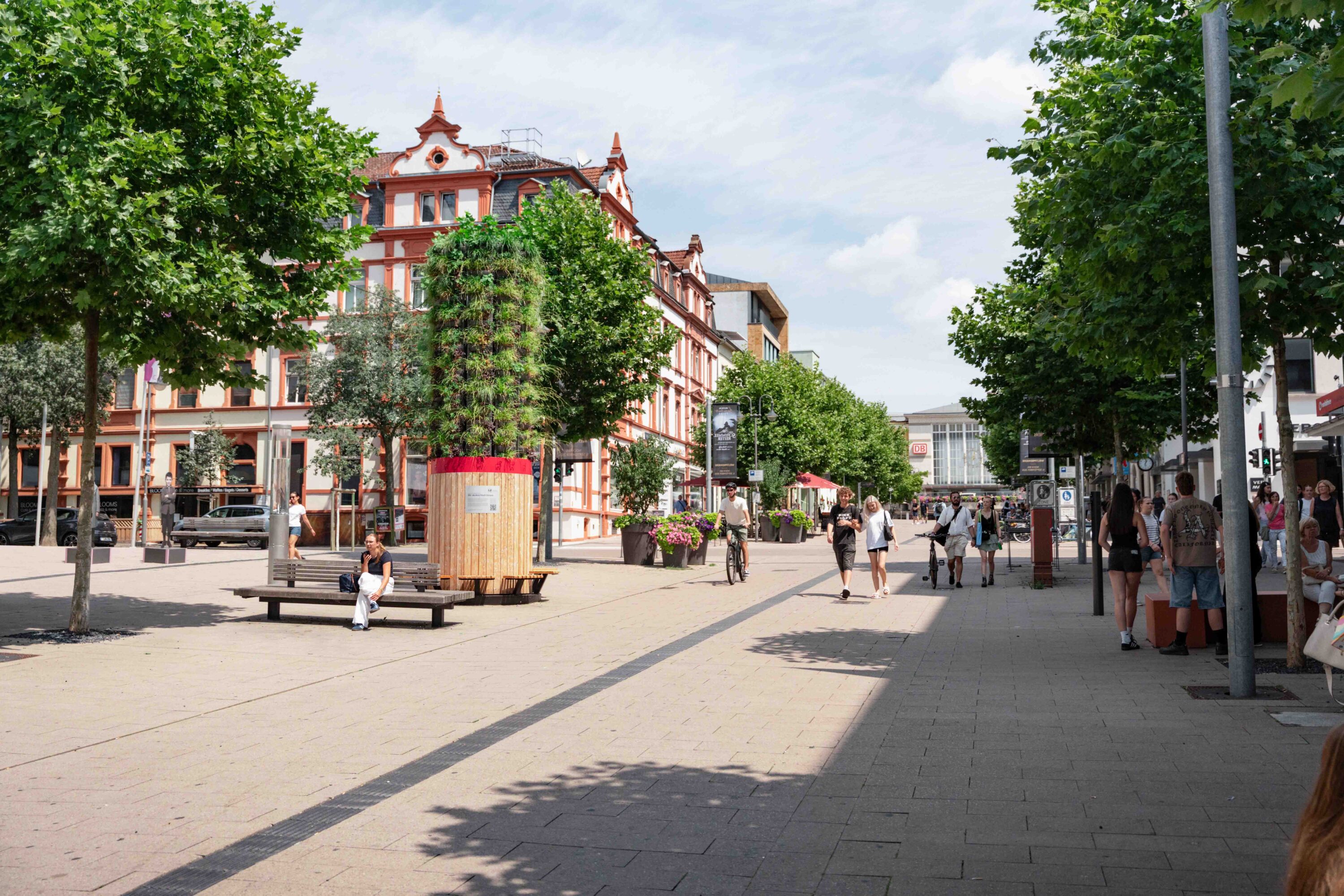
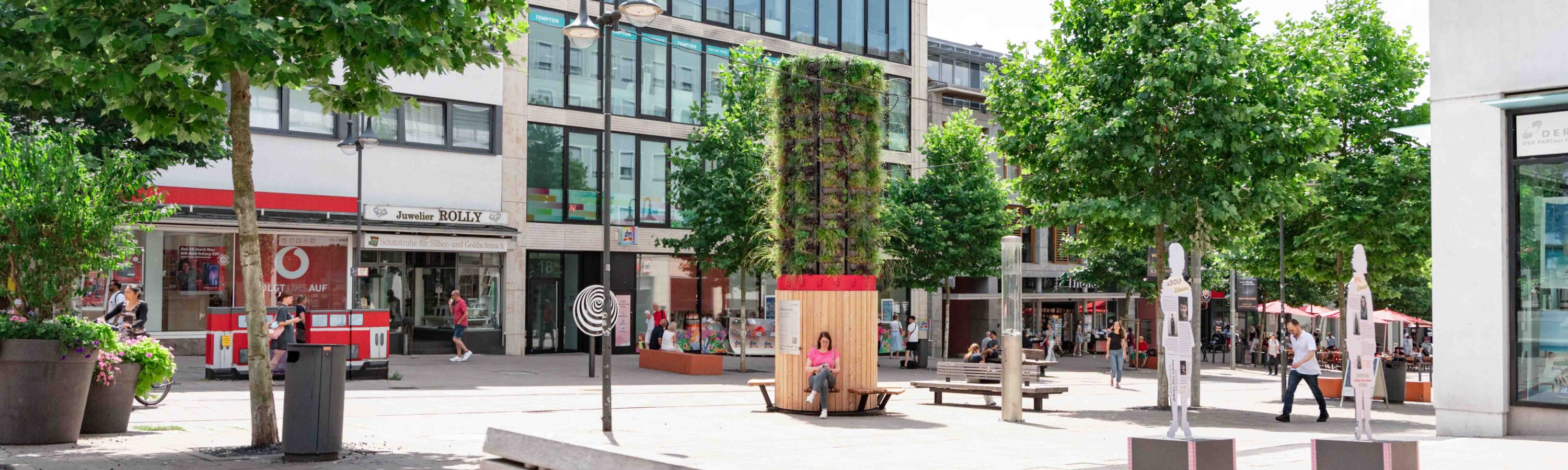
The ALPAKA Green Tower: free-standing vertical greening without a foundation in Fulda’s Bahnhofstraße.
A shortage of green space in city centres
Many city centres have little room left for new greenery: pavements are sealed, façades are already occupied, and there is simply no space for additional street trees. At the same time, demand is growing for greening that captures particulate matter, supports biodiversity, and enhances heavily sealed areas, precisely where conventional solutions reach their limits. One example of foundation-free vertical greening has stood in Fulda’s Bahnhofstraße since 29 May 2026: the ALPAKA Green Tower. The free-standing tower, around six metres tall, is fully covered in greenery using Mobilane’s MobiPanel system.
The challenge: greening without space for trees or façade systems
The request originally came from the city of Fulda itself. In the Bahnhofstraße, neither additional street trees nor wall-mounted greening systems were feasible, as the street space is continuously sealed and the adjoining façades are already occupied by shopfronts. The city was looking for a solution that could simply be placed in the street space without a foundation, without connecting to a façade, and without any permanent structural intervention and that could just as easily be relocated if needed. With this requirement, the city approached ALPAKA Innovation, in nearby Petersberg-Böckels. For the planting itself, ALPAKA opted for a system already proven on the market rather than developing its own greening solution.
Foundation-free vertical greening as the solution
The ALPAKA Green Tower combines a free-standing steel and timber structure with Mobilane’s MobiPanel system as the planted surface. GEFÄSSERIE carried out the greening, while ALPAKA developed the tower itself.
-
-
- Free-standing and foundation-free: approx. 6.0 m high, approx. 1.7 m in diameter, approx. 2.0 m base structure
- Modular MobiPanel cassette system: around 20 m² of planting area on just approx. 2 m² of footprint (roughly 90% space saving compared with ground-level planting)
- Integrated, automatic irrigation via a 1,160-litre water tank (around four weeks of autonomy in average weather conditions)
- Fully relocatable and reusable, with no residual trace left behind, suitable for permanent locations as well as temporary events
- Total filled weight (including the 1,160-litre tank): around 6,000 kg
-
Demonstrated impact: findings from the Hochschule Fulda study
The Laboratory for Mechatronics at Hochschule Fulda, led by Lara Ostermeyer, conducted a study examining the Green Tower’s contribution to capturing particulate matter and its effect on air temperature, CO2, and O2 in its surroundings. The study was based partly on a model calculation for the Bahnhofstraße: for the adjoining street sections, totalling around 250 m, 24 Green Towers were assumed at intervals of roughly 25 m in two rows.
Particulate matter capture (PM10) by the Green Tower
With a planting area of 20 m² per tower and an estimated leaf area index of 4 m² per m² (total leaf area: 80 m²), a single Green Tower can, according to the calculation, capture up to 640 grams of particulate matter (PM10: particulate matter with a diameter of less than 10 micrometres) before the leaves are “reset” by rainfall (20% washed off in light rain, 35% in moderate rain, 50% in heavy rain). As it rains in Fulda on average every 2.4 days, considerably more often than the calculated 6 to 13 days needed between rainfall events to reach that capacity, this uptake capacity is available almost continuously. Based on traffic data for the adjoining street sections (together around 25,000 vehicles and 894 buses on school days), the study calculated daily traffic-related PM10 emissions of around 580 grams (including tyre and brake wear). With the assumed 24 Green Towers, this figure could, according to the model calculation, be largely offset. For total PM10 emissions in the street space, however, of which traffic accounts for around 10%, or roughly 5.8 kg per day, 24 towers are not sufficient.
Effect on air temperature
For the immediate air temperature, the study calculated the effect analytically only within a radius of around 29 mm around the 1.5 m-diameter tower, and confirmed this with flow simulations (OpenFOAM) for a street model with multiple towers: temperature differences there were in the range of a few hundredths of a degree. The strongest cooling effect occurred under conditions of high temperature, low humidity, and high wind speed.
CO2 uptake and oxygen production of the Green Tower
According to the calculation, a Green Tower absorbs around 29.2 kg of CO2 per year and produces approximately 5.33 kg of O2. Compared with average annual per-capita CO2 emissions in Germany (7.98 tonnes) and a person’s annual O2 consumption (279.6 kg), each of these represents only a small share. Source for all figures in this section: Lara Ostermeyer, “Einfluss des ALPAKA Green Towers auf die Umgebung, insbesondere auf Temperatur und Feinstaubbelastung” (“The influence of the ALPAKA Green Tower on its surroundings, particularly on temperature and particulate matter pollution”), Laboratory for Mechatronics, Hochschule Fulda, 2026. [Link to the study in German here]
Foundation-free vertical greening: the Green Tower in figures
1. Up to 90% less space required
On around 2 m² of footprint, the Green Tower accommodates approximately 20 m² of MobiPanel planting: a space saving that is difficult to achieve by any other means in a densely built city centre such as Fulda’s.
2. A calculated contribution to particulate matter capture
According to the model calculation by Hochschule Fulda, a single Green Tower can capture up to 640 g of PM10; a network of 24 towers could largely offset the Bahnhofstraße’s daily traffic-related PM10 emissions of around 580 g.
3. Installed entirely without a foundation or façade connection
The tower stands free in the street space, requires no structural anchoring, and can be relocated without leaving any trace: ideal for city centres and temporary events.
4. Low maintenance thanks to automatic irrigation
An integrated 1,160-litre water tank automatically supplies the MobiPanel planting for around four weeks in average weather conditions before it needs refilling.
5. New habitat in the heart of the city
The continuously planted surface creates additional habitat for insects and visibly enhances a heavily sealed public space.
Summary at a glance
-
-
-
- Mobilane’s MobiPanel as the planted surface of the ALPAKA Green Tower in Fulda
- Around 20 m² of greenery on just 2 m² of footprint (approx. 90% space saving)
- Up to 640 g of PM10 capture per tower, according to the model calculation by Hochschule Fulda
- No foundation, no façade connection (free-standing and fully relocatable without residual trace)
- Automatic irrigation via a 1,160-litre tank, around four weeks of autonomy
-
-
Project partner for foundation-free vertical greening: GEFÄSSERIE and ALPAKA
GEFÄSSERIE – Die Wandbegrüner GmbH is a German company which draws on almost 40 years of experience in horticulture, around 10 of them specialising in façade and wall greening. Over this time, it has established itself as an expert in holistic greening concepts, from consultation and planning through to installation and maintenance. GEFÄSSERIE delivers façade greening for office buildings, hotels, and public institutions, tailoring each solution to the architecture and location. It also designs interiors with plant walls and room dividers to improve indoor climate and wellbeing. As a long-standing Mobilane partner, the company draws on a proven, site-appropriate plant range. GEFÄSSERIE additionally offers a comprehensive maintenance service for outdoor and indoor greening throughout Germany, with certified façade-greening consultants on its team. This makes the company a reliable partner for demanding greening projects, as demonstrated once again in the installation of ALPAKA’s Green Tower.
Frequently Asked Questions
A built-in 1,160-litre water tank supplies the plants automatically for around four weeks under average weather conditions before it needs refilling.
The ALPAKA Green Tower was inaugurated on 29 May 2026 during Hessentag on Fuldaer Bahnhofstraße. Because it can be relocated without leaving any trace, this type of structure works for both permanent placement and temporary use at changing locations.
Fully filled, including the water tank, the Green Tower weighs around 6,000 kilograms. Since it requires no foundation, it can be relocated with suitable equipment rather than being permanently fixed in place.
Fuldaer Bahnhofstraße is fully sealed, and the surrounding facades are already occupied by shopfronts. A free-standing system like the Green Tower needs neither open ground nor a facade connection.
Yes. Since the Green Tower requires no foundation or facade connection, the same principle can generally be applied in other city centres facing similar space constraints.
Technical documentation
Planners and architects can find the BIM model, AutoCAD drawing, and factsheet for the MobiPanel system on Mobilane’s download page.
Questions about MobiPanel for your project?
From planning and product selection through to delivery, Mobilane supports landscaping professionals with expert advice, practical recommendations, and tailored solutions for every project.