


Greening a glass facade, architecture firm in Germany
- MobiPanel living wall
- Location: Würzburg, Duitsland
- Dealer: GEFÄSSERIE - Die Wandbegrüner GmbH
| Location | Würzburg, Germany |
| Building | Architekturbüro Planwerk GmbH & Co.KG |
| Solution | MobiPanel: modular living wall system with pre-grown plants |
| Project partner | GEFÄSSERIE – Die Wandbegrüner GmbH |
| Application | Greening the outer frame of a large glass facade |
| Impact |  + Liveability + Liveability  + Wellbeing + Wellbeing |
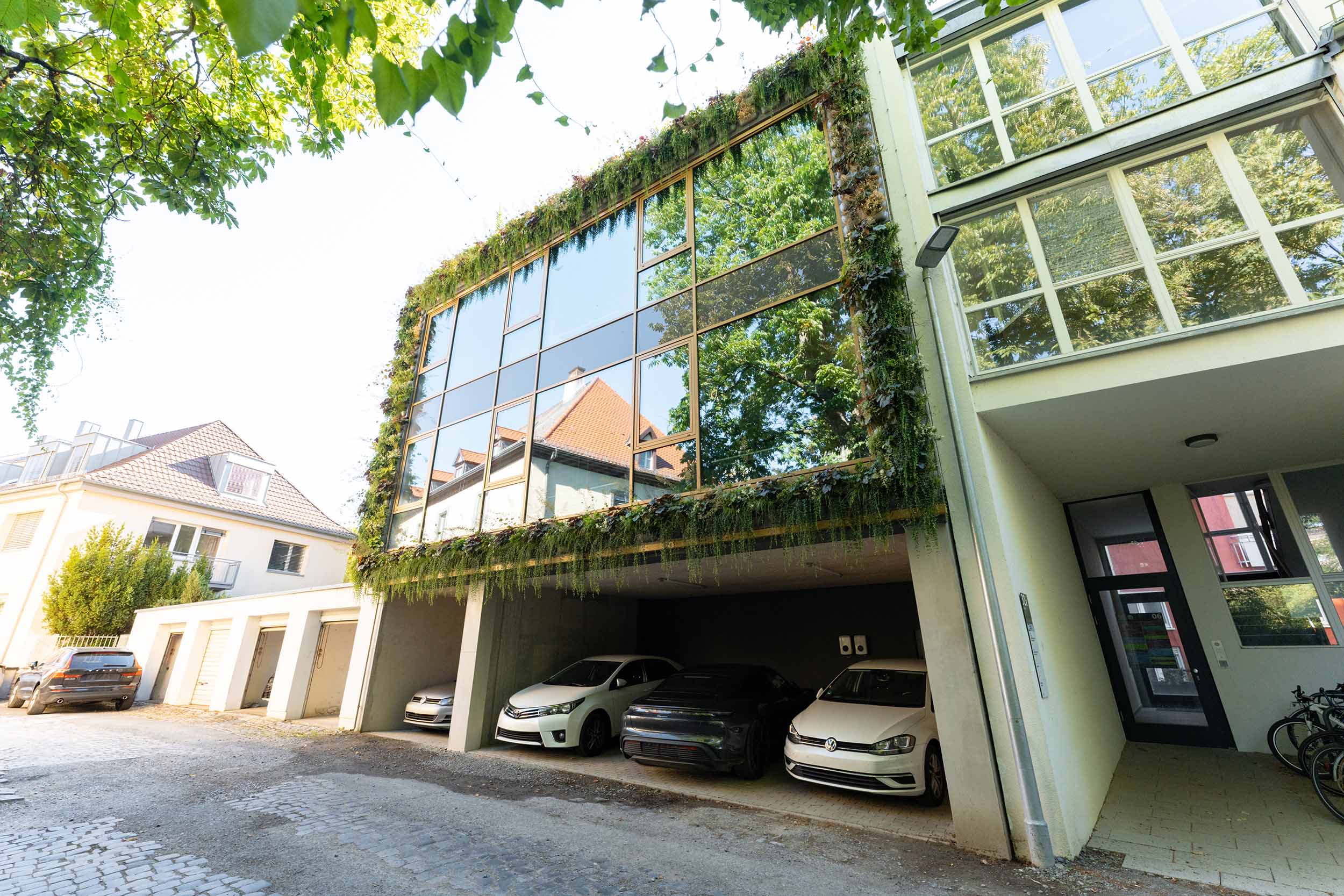
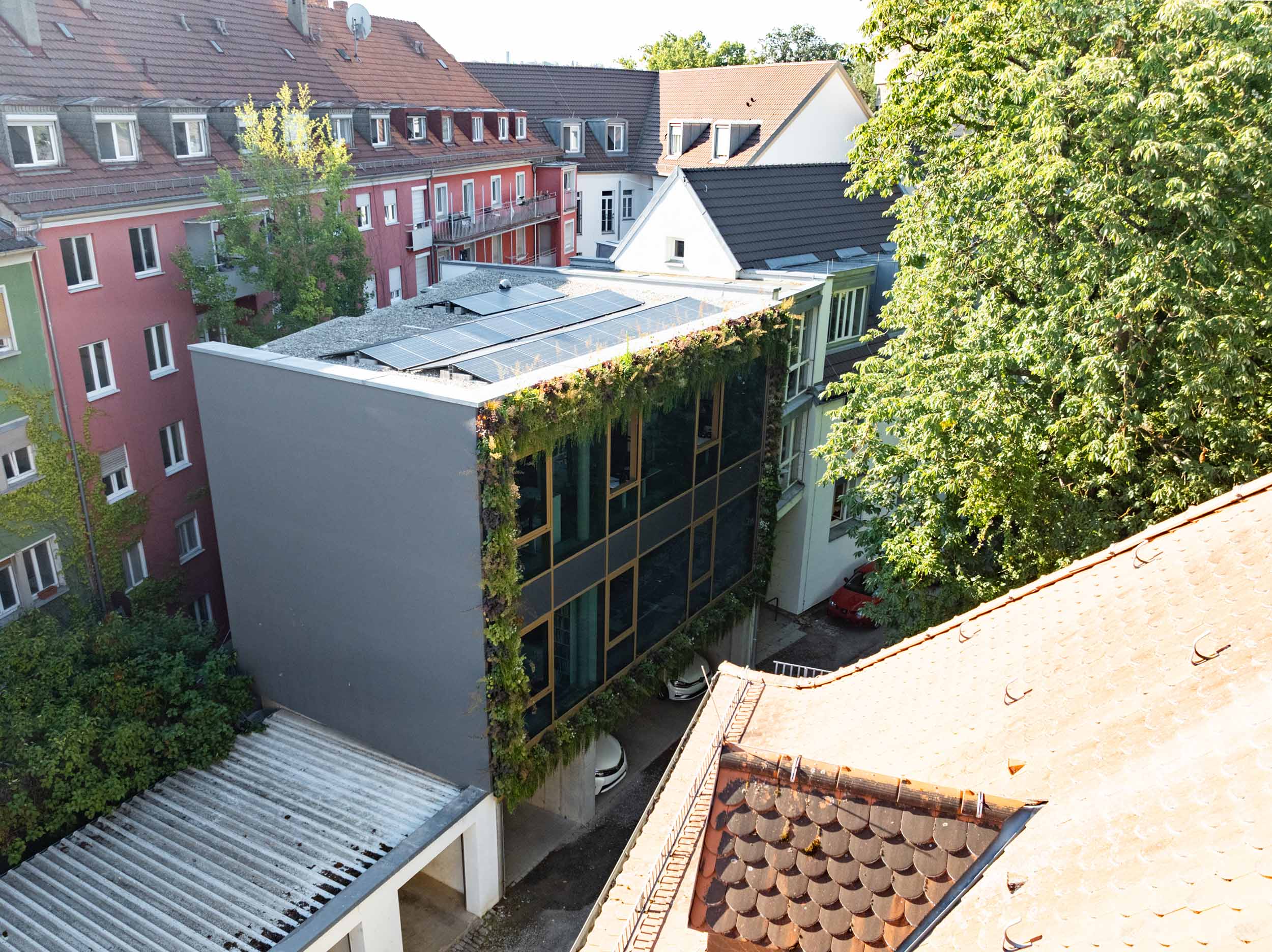
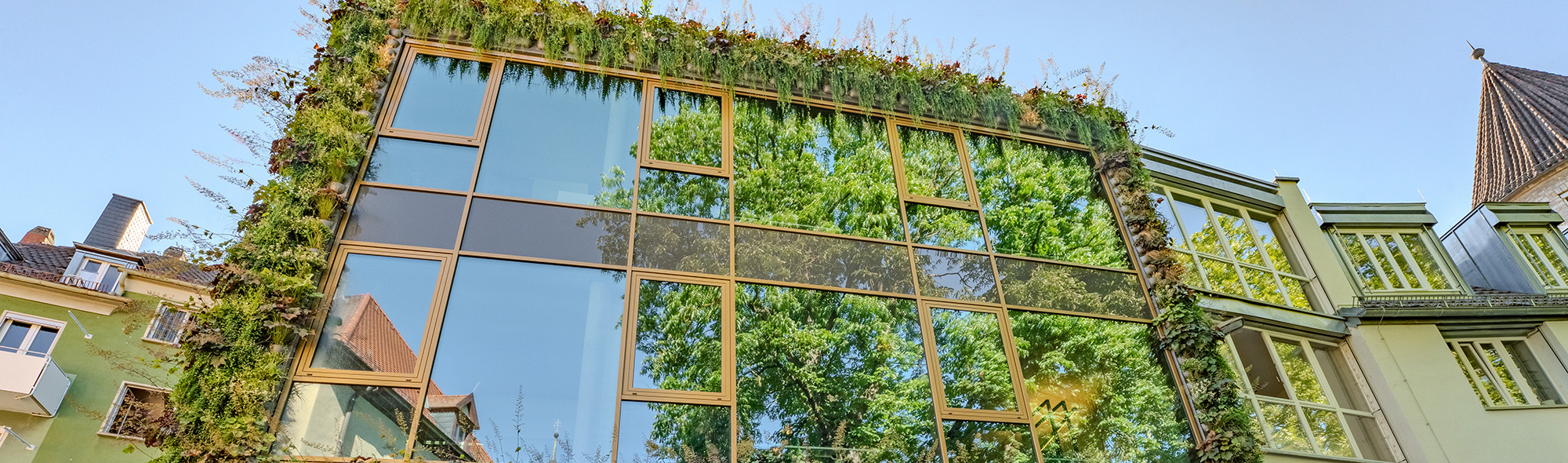
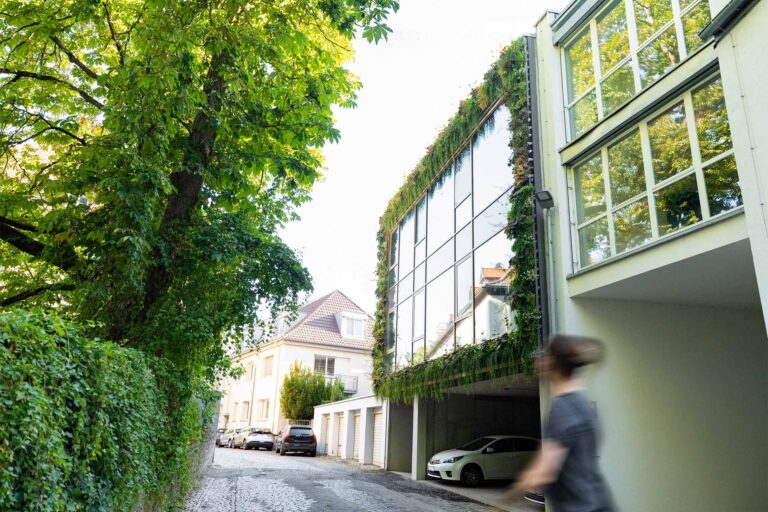
Treetops are reflected in the glass. Trailing stems draw soft lines along the frame. On this glass facade in Würzburg, the plants on the building and the surrounding greenery come together as a living painting, whose character changes with the light and the viewing angle. The building blends into the existing greenery around it rather than standing apart from it. Client Stefan Buttler wanted to show in Würzburg what architecture and greenery can achieve together. GEFÄSSERIE gave that idea an extra lightness with trailing plants along the top and bottom of the frame. Between the delicate stems and the reflected treetops, the result is a facade that invites a second look.
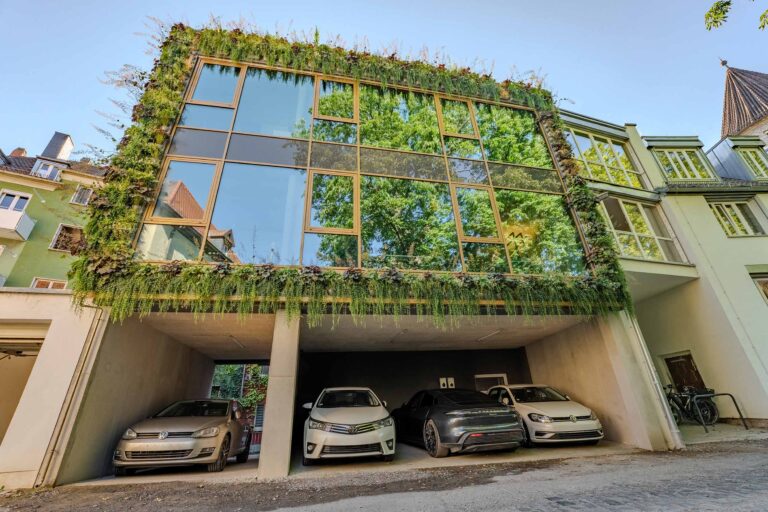
Green facade on a glass facade, connecting building and surrounding greenery
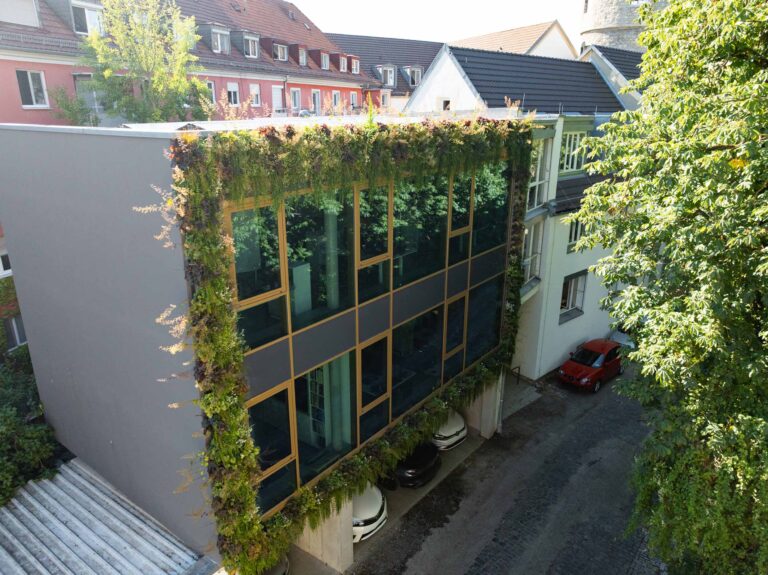
A green facade never stands alone. In Würzburg, the surrounding trees, hedges and green spaces were the starting point for greening the glass facade. Reflections of the treetops appear in its clear grid, and living plants along the edges echo those natural shapes. Particular attention went to the transition between frame and glass, where the planting softens the straight edges. Key to the plant choice was the south-west orientation. Along the top and bottom of the frame, GEFÄSSERIE chose trailing plants whose stems spill over the crisp edges. Building and surroundings come together in a single green image. Four elements make up the design:
-
- Living plants form the outer frame of the glazing.
- Trailing stems connect straight lines with natural forms.
- Different leaf textures and shades give the frame depth.
- Reflections draw the existing trees into the facade.
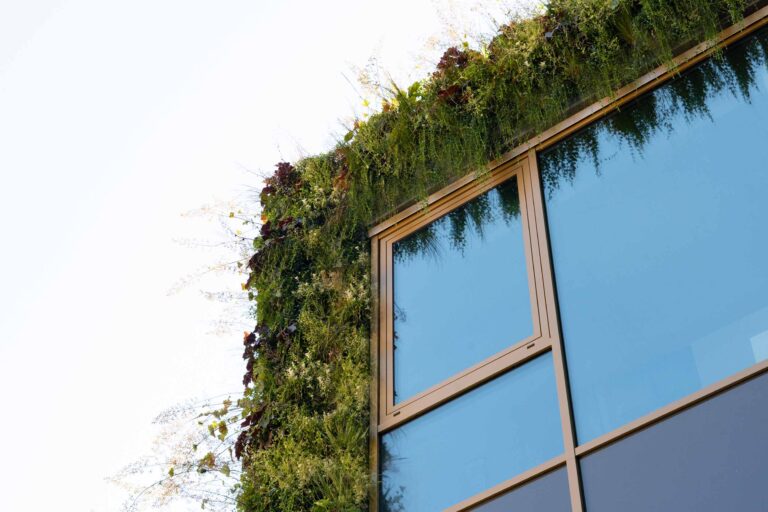
Foliage and colour give the frame its character
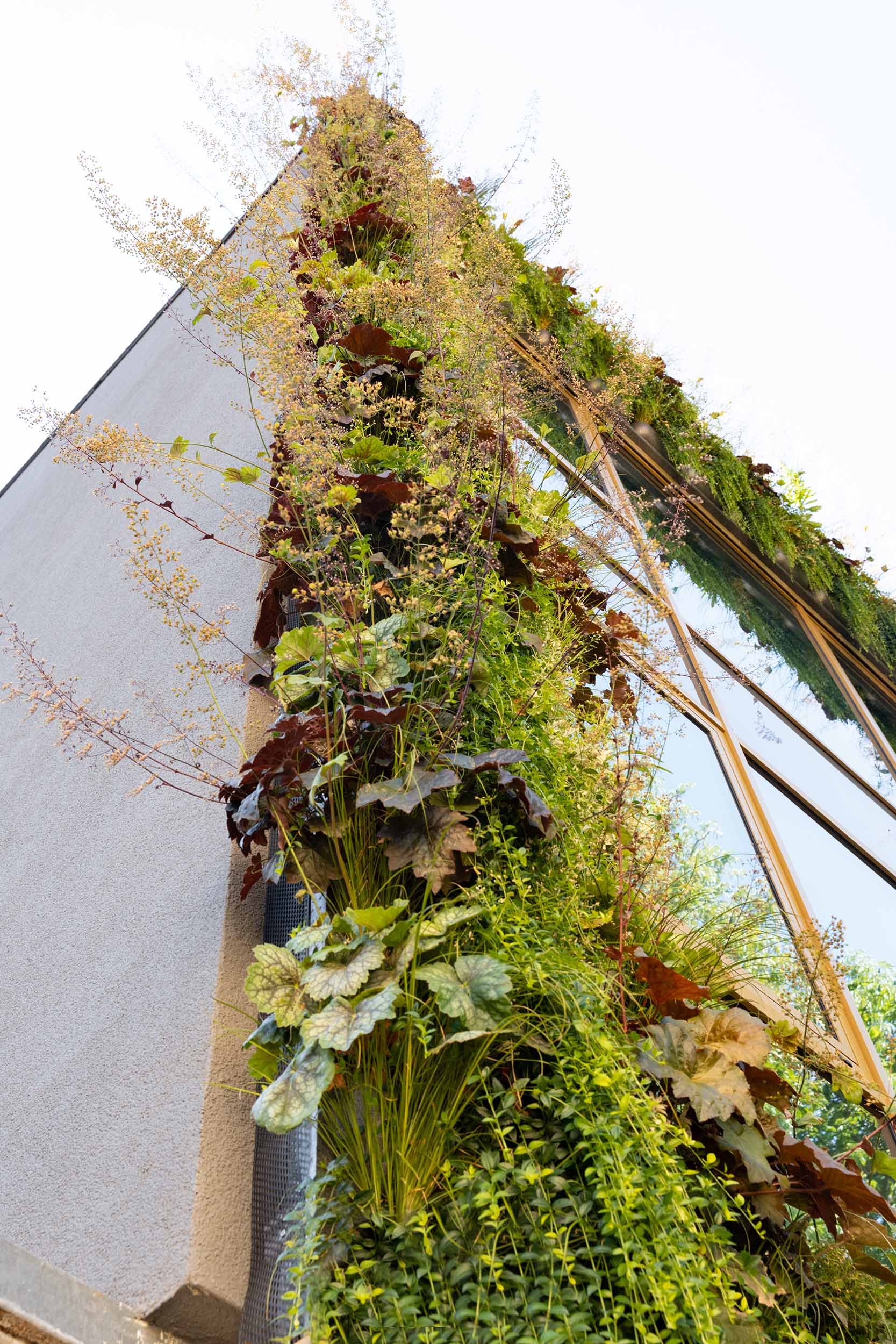
Each plant gives the frame a character of its own. With its creeping habit, Vinca minor ‘Elisa’ provides the trailing stems. Carex morrowii ‘Ice Dance’ reinforces that light effect with its fine, pale-edged leaves. Bright accents from Euonymus fortunei ‘Harlequin’ guide the eye along the planting. In between, the dark purple foliage of Heuchera micrantha ‘Palace Purple’ creates depth, while the sedge Carex ‘Prairie Fire’ contributes bronze to orange tones. Fine leaves next to broader ones, light markings next to dark blocks of colour: these contrasts make the frame interesting close up as well. Warmth comes from the palette of copper, orange and red set out in the project brief. Together with the green of the reflected treetops, this creates a layered image in which the eye moves back and forth between the foliage on the frame and the trees in the glass.
The plant selection at a glance
| Vinca minor ‘Elisa’ | Creeping, evergreen ground cover with glossy leaves; provides the trailing stems on the frame. |
| Carex morrowii ‘Ice Dance’ | Sedge with olive-green leaves and pale edges, approx. 30 to 50 cm tall; continues the light effect. |
| Euonymus fortunei ‘Harlequin’ | Green leaves with white edges, approx. 50 cm tall; provides bright accents. |
| Heuchera micrantha ‘Palace Purple’ | Red to purple, lobed leaves; adds depth and a palette of copper, orange and red. |
| Carex ‘Prairie Fire’ | Ornamental grass with fine, orange-red to bronze foliage, up to approx. 60 cm tall. |
A green painting of plants and reflections
Strength of this facade lies in the interplay of two green layers. Plants grow directly on the building, while the trees appear as reflections in the glass and so become part of the architecture. Photos of the project show how closely the two layers interact. Together they create what looks like a green painting.
1. Two green layers become one image
Living planting frames the reflected treetops. Anyone looking at the facade sees the two merge into one green image that reaches beyond the planted edges themselves. It shows how close the building is to its surroundings.
2. Glass reflects its surroundings
Trees, sky and neighbouring buildings appear in the panes. The reflections change with the light and the viewing angle, and with them the appearance of the facade. The glass takes on the character of the place; the planting gives those changing images a living frame.
3. Trailing plants bring lightness
Trailing stems break up the crisp edges of the frame. Fine sedge leaves and broader, dark foliage give the planting varied outlines. The clean architecture takes on a softer look, with room for the irregular and the naturally grown.
4. Building blends into the surrounding greenery
Green facade around the glass facade connects with the existing greenery rather than standing apart from it. Living plants and reflected trees together shape the face of the building. The planting invites people to experience the architecture together with its natural setting.
The project at a glance: greening a glass facade
-
- The green facade blends into the existing greenery of the surroundings.
- Living plants and reflected trees form a single motif.
- Trailing stems loosen up the geometric frame.
- Glass increases the visible greenery through reflections.
Planwerk’s architectural concept
Stefan Buttler of architecture firm Planwerk GmbH & Co.KG wanted to show in Würzburg what the interplay of architecture and greenery can offer. The glass facade with its living frame makes that ambition visible: the building takes the trees around it into its own appearance.
Green facade project partner: GEFÄSSERIE
GEFÄSSERIE Die Wandbegrüner GmbH is based in Fuchsstadt, in the Lower Franconia region of Germany. Its experience in the green sector spans almost 40 years, around ten of them specialising in green facades and living walls. Over that time, the company has become a specialist in integrated green concepts, from advice and design to installation and maintenance. For offices, hotels and public buildings, it creates green facades that are always tailored to the architecture and the location. Inside buildings, GEFÄSSERIE installs indoor living walls and room dividers that improve the indoor climate and wellbeing. As an established Mobilane partner, the company works with a proven plant range suited to each location. Throughout Germany, GEFÄSSERIE also maintains outdoor and indoor greenery. Certified green facade consultants are part of the team, making the company a reliable partner for complex green projects.
Technical documentation
Designers and architects can find the BIM Model, AutoCAD drawing and Factsheet for MobiPanel on the Mobilane Downloads page.
Frequently Asked Questions
Yes, orientation is one of the most important site conditions. It determines how much sun, heat and wind the plants receive. Plant selection and water requirements depend on this.
South-west-facing facades receive a lot of afternoon sun and heat up considerably. Plants on these facades therefore need to tolerate sun and heat. In Würzburg, the south-west orientation determined the choice of Vinca minor ‘Elisa’, Carex morrowii ‘Ice Dance’, Carex ‘Prairie Fire’, Euonymus fortunei ‘Harlequin’ and Heuchera micrantha ‘Palace Purple’.
Plant selection defines the look of a green facade. Different leaf colours, growth habits and textures create contrast and depth. In Würzburg, green, red and purple tones form a lively planting scheme that contrasts with the clean lines of the architecture. Beyond appearance, the plants must also suit the light and site conditions.
Glass reflects the surroundings, while the planting adds a living, three-dimensional layer to the building. In Würzburg, treetops and sky are reflected in the glass, and the plants along the frame soften the clean architecture. That interplay changes with the light and the seasons. As a result, the boundaries between building and surroundings begin to blur.
Key factors are the position of trees, the lines of sight and the properties of the glass, as these determine how the surroundings appear in it. Orientation also matters for plant selection, as does the coordination of mounting, water supply and access for maintenance.
Questions about MobiPanel for your project?
Your partner for professional greening projects
From planning and product selection to delivery: Mobilane supports architects, landscapers and installers with expert advice, practical recommendations and tailored solutions for every project.